Farming with Nature, for People and Planet
Context
The African continent faces a number of complex challenges related to climate change, and the degradation of natural resources. Additionally, the population in Africa continues to grow at a rapid pace, which leads to increasing demand for food and changing consumption habits. Both trends place immense pressure on the agricultural sector. Agroecology, which focuses on the application of ecological principles to agricultural systems, has the potential to address these challenges and contribute to transform the continent’s agricultural practices. Agroecology can significantly contribute to biodiversity conservation beyond the farm in a broad range of landscape.
Agroecology describes complex farming systems, which are adapted to local conditions, by building on a high diversity of crop and animal species and practices – such as practices such as mixed cropping, intercropping, agroforestry, and livestock integration – that preserve soil structure and fertility, water availability. However, it is not only a production system. Environmental, social, economic, ethical and development issues are as relevant for agroecological transition. Agroecology is a holistic and system-based approach that is conducive to better biodiversity outcomes in the agricultural sector. Agroecological transformation is a truly interdisciplinary endeavour. It requires new adapted knowledge for all food system actors. Further, it also needs a strong food governance with interventions at different level (local, territorial, and value chain) and coherent public policies. There is a need for policy coherence and common narrative within the agricultural and biodiversity conservation sectors to materialise the transformative power of agroecology.
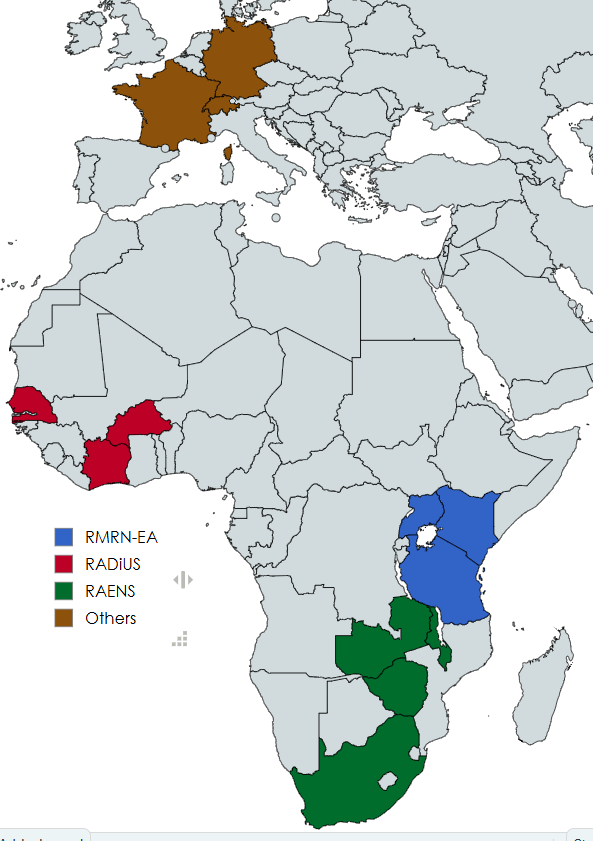
Our Coverage
Objectives
The overall objective (Impact) of the action is to: Increase Science Technology and Innovation capacities of RCoEs in agroecology contributing to a green transition in Sub Saharan Africa. To achieve this overall objective, three strategic objectives have been defined: These strategic objectives (SOs) are:
-
-
- Strengthen scientific and technological capacities of RCoEs in Agroecology to produce, collect, access, process, share data / information and carry out research activities using a gender-sensitive approach.
- Increase RCoEs in agroecology contribution to transformative quality research and scientific knowledge generation.
- Enhance RCoEs in agroecology gender-sensitive support to practitioners, scientists and policymakers.
-
Expected Outcomes
Justification of Action
Architecture of the Project
- Strengthened scientific and technological capacities of RMRNs in Agroecology to produce, collect, access, process, share data / information and carry out research activities using a gender-sensitive approach.
- Increased RMRNs in agroecology contributions to a transformative quality research and scientific knowledge generation.
- Enhanced RMRNs in agroecology support to practitioners, scientists and policymakers.
Despite the importance and benefits of agroecology to increase agricultural productivity and eventual contribution to improving food security and nutrition in SAA, the practice is faced with numerous challenges. The challenges affecting the principles and practice of agroecology in SAA include; low appreciation of the definition and concepts of agroecology, inadequate education, training, and knowledge sharing; inadequate research approach and funding; inadequate policies supporting agroecology, coupled with low consumer awareness. In SSA, farmers use agroecology practices within extension, research, and policy regimes that are not always supportive and may actively encourage other, non-agroecological alternatives. In some cases, farmers are discouraged from using agroecological practices by various institutions (e.g. government, extension, private sector) with stated concerns about risks to food security, agricultural productivity and threats to farmer livelihoods if they are used.
The transition towards agroecological food systems and the development of both productive and resilient farming systems and value chains are complex processes. It requires new knowledge, competencies and policies to address complex problems and co-create solution based on agroecological principles and the integration of scientific and local knowledge. The European Union (EU) regional Multi-year Indicative Programme (MIP) for Africa aims at funding interventions in Africa in several domains including supporting multi-stakeholder consortia to bring agroecological innovations to scale with strong contribution of research but championed by Africa based institutions. Moreover, i) while Europe has advanced inventories and typologies of agroecological practices, Africa with a wider ecological diversity is yet to adequately document, utilise and share principles and practices from the multiplicity and complexity of agroecology actors. ii) Globally and within in Africa in particular, there is a general lack of knowledge to characterize and use of agrobiodiversity an approach to strengthen and improve local food systems. iii) Due to inadequate research, lack of technology development and ineffective regulatory frameworks the scaling of bio-input production and marketing remains a underdeveloped in Africa. iv) Increased use and investments in digital ‘solutions’ has not had substantial impact on farmers’ decisions and practices in agro ecology.
The action to strengthening Regional Centres of Excellence for agroecology in sub-Saharan Africa is aimed to address these challenges. It fits within the European Union (EU) alignment to the 2030 Agenda Sustainable Development Goals, the Paris Agreement and the Convention on Biological Diversity to help eradicate poverty, reduce inequalities and achieve sustainable development. The proposed action is highly relevant to the Africa-EU partnership’s agriculture and food systems development priorities.
The actions under this project are intended to strengthen the Regional Multi-actor Research Networks (RMRNS) for agroecology. The RMRNs in this proposed action are described as a group of organisations providing leadership in scientific processes and knowledge creation focusing on agro-ecological and sustainable agri-food systems. These include Africa-based and Africa-led research organisations (CORAF, ASARECA, and CCARDESA), universities under the RUFORUM Network and Africa in general and other research institutions. The proposed actions will enhance interactions with key African partners aimed to fine tune the concept and the content of RMRNs for food system with an agroecological angle in line with the EU Farm to Fork strategy. The proposed actions will further promote partnership with relevant institutions such as NGOs, CSOs, the private sector, and financial institutions.